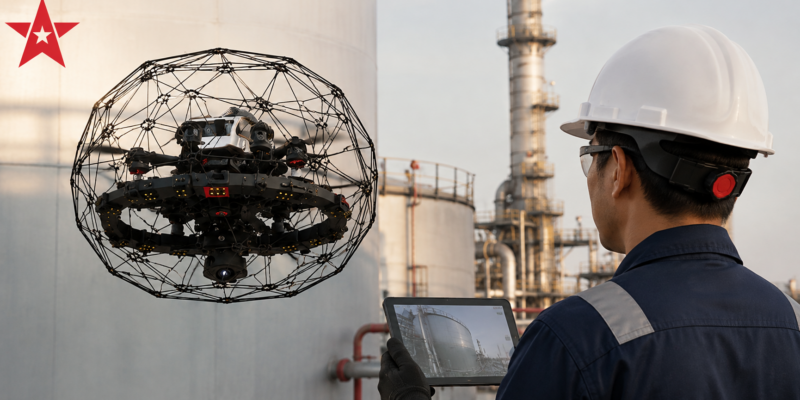
Areas that are hard, high, small or expensive to reach are often found in industrial assets. Surveys of these places do not necessarily involve scaffolding and elaborate shutdown preparations or sending men into difficult places. The use of drone services in Singapore is becoming more applicable to industrial inspection due to the fact that unmanned aircraft are able to record detailed visual data of sites that would otherwise demand considerable access planning.
Inspection of marine assets, offshore structures, tanks, buildings or other industrial facilities by drones can be part of a broader asset integrity and maintenance approach by companies that operate plants.
A-Star Testing and Inspection provide NDT, advanced inspection, marine and offshore inspection, rope access, underwater inspection and other specialized services to industrial customers. Its website also focuses on NDT skills combined with rope access and underwater skills.
What Are Drone Services in Singapore?
In an industrial context, drone services go beyond taking aerial photographs. They may include scheduled UAV flights to conduct visual inspections and document assets, as well as condition monitoring, surveying, and data collection of inspections.
An inspection team can be observed in a safer location, even as a drone with an appropriate camera flies to higher or inaccessible locations.
The common uses may be:
- Elevated structure visual checks.
- Construction and building checks.
- Onshore and offshore surveys of assets.
- Structural and tank inspections.
- Façade and roof evaluation.
- Infrastructure documentation
- Primary examination of corrosion or surface condition.
The major difference is that drone inspection is a data-collection approach in general, not a substitute for all NDT. In places where a defect needs a specialized NDT technique, the drone results can assist the inspectors to decide where additional investigation is necessary.
How Does Industrial Drone Inspection Work?
A professional inspection usually begins prior to the drone flying.
1. Inspection planning
The inspection team provides the identification of the asset, inspection goal, access controls, and inspection areas. The intended flight must be in line with the scope of the inspection and not just taking a general aerial view.
2. Safety and regulatory checks
CAAS applies to commercial drone activities in Singapore. An operator permit, activity permit and qualified personnel might be needed depending on the operation. According to CAAS, commercial activities need an Unmanned Aircraft Pilot Licence, with the requirements and exemptions in this area.
3. Data capture
Images or video of a given area of inspection are taken by the UAV. The usefulness of the resultant information can be influenced by the flight paths, the camera positioning, the lighting and distance to the asset.
4. Technical review
Imagery gathered is assessed by qualified staff. Observable damage can be defined as surface damage, decoating, deformation, visibly evident cracks, signs of corrosion or other disorders that need further investigation.
5. Reporting and follow-up
Findings of the inspection can be compiled in the form of a technical report and include photographs, observations, and suggestions on further inspection where needed.
This is particularly essential as the final step. The set of drone photographs is not necessarily an engineering inspection report.
Where Can Industrial Drone Inspection Be Used?
Marine and offshore assets
Marine UAV inspection may be applicable near marine buildings, offshore facilities, and other large infrastructure where access may prove difficult.
A-Star already caters to marine and offshore sectors and offers inspection services related to it such as hull inspection, UTM and conventional and advanced NDT.
Tanks and industrial structures
Areas that are hard to check at a ground level may be found on large tanks, raised structures, and outside surfaces. Drone imagery may give a preliminary overview of the visual image and assist in determining areas that might need further examination.
Buildings and construction
Drones are able to take exterior images of roofs, facades, buildings, and construction developments. This can facilitate documentation and assist inspection teams to find areas of further evaluation.
Difficult-to-access locations
One of the most powerful uses is reaching places which would otherwise require much preparation to reach by conventional means.
Nevertheless, it depends on the purpose of inspection to have the right answer. Fine inspection may require rope access, scaffolding, underwater inspection, or special NDT.
Benefits of Drone-Based Inspection
The importance of industrial UAVs services is in the integration of aerial access and engineering wisdom.
Such advantages may be:
- Reduced need for some temporary access arrangements
- Increased visual coverage in large areas.
- Improved record keeping of remote areas.
- Less exposure to some of the hazards that are associated with access.
- High-resolution visual records
- Less difficult comparison when repeating the inspections.
- Greater focus on areas that need to be subjected to NDT.
An example is a drone that is able to detect a suspicious area on a higher object. The information can be used to decide where the inspection team will focus their attention, by not deploying a large access system to the whole structure at once, but by concentrating on the area that needs more scrutiny.
Drone Inspection vs Traditional Access
| Factor | Drone Inspection | Traditional Access |
| Elevated areas | Very suitable for visual checks | May require scaffolding or rope access |
| Large structures | Fast visual coverage | Can take longer |
| Detailed NDT | Usually requires additional methods | Can directly support hands-on NDT |
| Human access | Can reduce some access requirements | Personnel physically access the asset |
| Data capture | Strong photographic/video record | Depends on inspection method |
| Complex environments | Requires careful flight planning | May be better in some confined areas |
Drone vs. traditional inspection is not necessarily the best method, but a combination of both.
The current service offerings by A-Star reflect this multi-methodology to include sophisticated NDT like the PAUT, TOFD, and ACFM and rope access and other inspection services.
Singapore Drone Regulations for Commercial Inspection
This is one of the things that should be considered when seeking commercial drone services.
In Singapore, CAAS controls the activities of unmanned aircraft. Its present structure encompasses aspects such as registration, licensing of pilots, operator and activity licenses, remote identification, and flight restriction.
According to CAAS, the operator permits evaluate aspects like organizational arrangements, safety procedures, risk assessments, airworthiness of aircraft, and competency of personnel.
No-fly zones and other areas where permits might be obligatory also exist. CAAS advises to ensure that the relevant flying zones and conditions are met and checked prior to flying a drone.
Thus, companies should not choose a provider depending on the quality and price of cameras only. Equally important are regulatory compliance, competent operators, risk assessment, and inspection expertise.
How to Choose a Drone Inspection Provider
Prior to hiring an industrial drone inspection business, inquire:
- Is the provider familiar with industrial check-ups?
- Do the drone operations meet the relevant Singapore requirements?
- Is the team qualified with inspection staff?
- Is the provider able to perform a visual inspection alongside NDT where necessary?
- Is the company capable of inspecting marine, offshore or industrial assets?
- Will you be given a formal inspection report?
- Is it possible to follow up findings with the help of another way of inspection?
In the case of industrial assets, the best provider may also not be the company that provides the cheapest flight. The provider is the one who can convert aerial data into valuable engineering information.
Expert Tips
Drones should be considered as an element of an inspection strategy instead of a single solution.
Prior to the flight, clearly state the purpose of the inspection. A request like: inspect the tank is not helpful as compared to the surfaces, components, areas of perceived problems, and deliverables required.
Also ensure that the quality of images is suitable. The value of the collected data can be diminished by poor lighting, huge distance, reflections, vibrations, or inappropriate camera angles.
Above all, consider the results of drone inspection as a guide to further investigation when the state of an asset cannot be determined only by visual evidence.
Common Mistakes
The most prevalent issues are selecting a provider by price alone, ignoring CAAS needs, gathering vast amounts of footage without a specified inspection scope, believing visible imagery can fill all NDT techniques, and not defining what the finished report must include.
Planning, flight safety, data collection, technical interpretation and reporting should be integrated in a professional workflow.
Key Takeaways
- Drones used in industry can be a valuable visual help to hard-to-reach sites.
- The marine, offshore, construction, and industrial property can be assisted by drone inspection.
- UAV data may assist in determining areas where additional analysis is needed.
- Drone inspection is not used to substitute all NDT techniques.
- Commercial activities in Singapore have to comply with the existing CAAS requirements.
- The best results are a combination of qualified inspection expertise and drone technology.
Pros and Cons
Pros
- Fast visual coverage
- Applicable in hard-to-reach locations.
- Strong photographic documentation
- Is able to support safer inspection planning.
- Helps focus on in-depth analyses.
Cons
- Environment and weather may impact operations.
- It has regulatory requirements that ought to be considered.
- There are technical constraints of visual inspection.
- Some defects require specialist NDT
- Flight planning is mandatory in the surroundings of industrial complexities.
Summary
Industrial UAV services are becoming a helpful component of the current inspection planning. It does not merely matter that a drone can fly over an asset, and its value is the highest. The actual worth is to gather valuable inspection data and correlate the information with professional engineering evaluation.
In the case of Singapore’s marine, offshore, petrochemical, construction and industrial industries, this method can be used to supplement the existing techniques of inspection and assist the teams to know where more in-depth analysis might need to be done.
Frequently Asked Questions
Q1. What are drone services in Singapore?
Ans: Commercial UAV activities displayed in the drone services in Singapore can be aerial inspection, surveying, visual documentation, and industrial asset assessment, subject to the CAAS requirements in Singapore.
Q2. What are industrial drones used to do?
Ans: Industrial drones are employed in visual inspection, documenting, surveying, checking the structure, and accessing inaccessible areas.
Q3. How does drone inspection work?
Ans: An inspection is a standard process that will entail the determination of the scope of inspection, safety and regulation inspections, aerial photography, data analysis, and compilation of a report on the inspection.
Q4. Is the use of commercial drones legal in Singapore?
Ans: The answer is yes; commercial drone activities are allowed provided that the operator meets the relevant regulatory requirements in Singapore. CAAS controls the operation of unmanned aircraft and licensing.
Q5. Are there any commercial drone pilots licensed in Singapore?
Ans: According to CAAS, commercial, non-recreational or non-educational unmanned aircraft operations must have a UAPL with possible exemptions.
Q6. Are drones able to survey offshore platforms?
Ans: Yes. Drones may be helpful in performing visual inspection of appropriate offshore structures and hard to reach locations, although the specific inspection procedure is determined by the asset and the area covered.
Q7. Are drones able to detect corrosion?
Ans: Drones are able to detect signs of corrosion, coating damage, or surface damage by visually surveying the area. Appropriate NDT methods may be necessary to confirm and size defects.
Q8. Could drone inspection be a substitute for NDT?
Ans: Not generally. The visual inspection of drones can be used to supplement NDT, yet particular defects might need specific methods like ultrasonic tests, PAUT, TOFD, ACFM or radiography.
Q9. What is it that I want in a drone inspection company?
Ans: Seek industrial inspection background, authorized staff, adherence to regulations, proper equipment, transparent reporting, and provision of supplementary inspection procedures.
Q10. What is the purpose of industrial inspection with drones?
Ans: Drones can also enable quick visual inspection of high or inaccessible places, generate valuable photographic documents, and guide inspection teams in places to focus on in future investigation.
Conclusion
The requirement for drone services in Singapore is strongly linked with the necessity to survey the assets effectively and deal with the access, safety, and operation limitations.
In the case of industrial usage, drones are to be viewed as a part of a larger inspection programme. Potential areas of concern can be determined by visual data, and when significant inspection areas are identified, methods like ultrasonic testing, PAUT, TOFD, ACFM, radiography, rope access or underwater inspection can be employed where the inspection scope necessitates such methods.
The ability to combine traditional NDT, sophisticated NDT, marine and offshore inspection, rope access and underwater inspections offered by A-Star Testing & Inspection lends great credence to this integrated method.
Companies intending to undertake an industrial inspection must thus consider what is under the drone and scrutinize the individuals, processes, regulatory adherence, inspection practices and reporting potential of the technology.